08/26/2026
The Rest of the Math: Locum Tenens Total Compensation Beyond the Base Rate

Subscribe to our newsletter
By subscribing you agree to with our Privacy Policy.
In Part 1 of this OBGYN locum compensation series, we worked through what OBGYN locum tenens actually pays per working day once you factor in call structure — and why the posted hourly on a job board only captures a third to a half of the picture. A realistic OBGYN locum week tends to look like three clinic days plus two 24-hour call shifts, with base value landing somewhere around $24,500 before anything else is layered in.
That's the base. It isn't the full locum tenens total compensation package.
This piece walks through everything else: holiday pay, the travel package, points and miles, 1099 deductions, and the line items you're not paying for as a locum that an employed physician quietly absorbs. The examples here use OBGYN because that's the specialty we modeled in Part 1, but the rest of the math applies across almost every locum tenens specialty. None of these line items show up on a job listing. All of them show up in your year-end total.
Holidays and overtime
Holiday premiums on Era assignments typically pay 1.5 times your base rate, primarily driven by the client's contract standards rather than agency policy. Which days qualify varies — some clients honor the federal calendar, some add a few clinical-coverage holidays of their own. Worth asking before you sign which holidays the assignment actually treats as premium days, and what the multiplier is.
Overtime is less common in OBGYN locums than in some other specialties because most OBGYN assignments are structured around call-inclusive daily or hourly rates rather than scheduled shifts that can spill over. When OT does come into play, the rate and trigger are spelled out in the assignment contract — not something you want to discover after the fact. Our Advanced Guide to Locum Tenens Salary and Contract Negotiations walks through how these line items typically appear in writing.
The travel package
A fully-covered Era travel package — round-trip airfare, ground transportation, lodging, and a daily per diem for meals and incidentals — typically runs $2,000 to $3,000 per assignment week in real dollar value. The math under that number:
- Lodging: $150–$200 per night for seven nights runs $1,050 to $1,400.
- Ground transportation: rental car or mileage reimbursement, generally $300 to $575 for the week.
- Airfare: $300 to $500 round-trip on most assignments.
- Per diem: meals and incidentals at GSA-style rates, roughly $415 to $560 for a seven-day week.
Rural assignments tend toward the lower end of that range — cheaper lodging, often a rental car instead of urban ride-share. Coastal and major-metro assignments trend toward the higher end.
None of it is income, so none of it is taxed. It is, however, money you are not spending out of pocket while you earn the base rate.
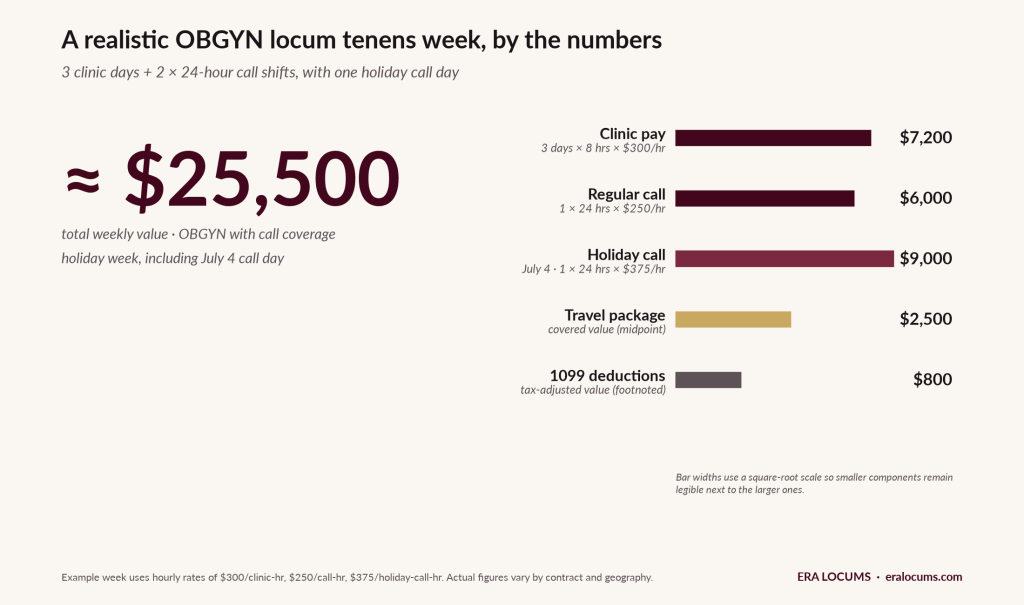
To make this concrete: take a realistic OBGYN locum week — three clinic days at roughly $4,500 each plus two 24-hour call shifts at roughly $5,500 each — and assume one of the call shifts lands on July 4th, the way Independence Day falls this year. Stack the holiday premium, the typical Era travel package, and the tax-adjusted value of legitimate 1099 deductions on top of the base. Here's what that single week is actually worth.
Chart: A realistic OBGYN locum week — base, holiday premium (July 4 example), covered travel, and tax-adjusted 1099 deductions. Era Locums, 2026.
Points and miles
A line item that doesn't show up in any package value but matters more than physicians expect: hotel and airline loyalty points accrue on your personal accounts, even when Era or the client is paying the bill.
Over a year of regular assignments, that's enough hotel points for family vacations and enough airline status to change how every subsequent trip — personal or professional — feels. We mention it because new-to-locums physicians often don't realize the points belong to them, not the agency. They do.
1099 deductions
As an independent contractor, you can deduct legitimate business expenses against your locums income. The IRS standard is that deductible business expenses must be ordinary and necessary for your trade or business. See the IRS Credits and deductions for businesses and Guide to business expense resources for the underlying framework.
The categories that come up most often for locums physicians:
- Equipment and supplies: laptop, stethoscope, scrubs, work bag, and any clinical tools you bring to the assignment.
- Professional development: CME courses and conferences, licensing fees, board certification fees, professional society dues, medical journals, and subscriptions.
- Operational: work phone plan, work internet, home office space (if it qualifies under IRS home office rules), business meals during travel, laundry on assignment, and scrubs cleaning.
Talk to a CPA who knows physician 1099 work before you claim anything. The wrong deductions filed the wrong way will cost you more than the right ones save you.
For a category-by-category walkthrough of what most locum tenens physicians can actually deduct, our 1099 Physician Tax Deductions You Should Take in 2026 post is the deep dive. For the broader picture of how 1099 status affects estimated taxes and self-employment tax, see Locum Tenens Taxes.
What you're not paying for as a locum physician
This is the line of the math many physicians don't consider. As a 1099 working through a locums agency, you're not paying for:
- Malpractice insurance, including tail coverage on most agency arrangements. For an OBGYN, this is meaningful — OBGYN malpractice premiums run among the highest of any specialty, and tail coverage at the end of an employed position can run substantial. Our How Much Is Malpractice Insurance? post breaks down the typical ranges by specialty.
- Credentialing infrastructure. The agency handles state licensure paperwork, hospital privileging, payer enrollment, and the dozens of forms and follow-ups behind each new assignment. Our Credentialing overview walks through what's involved and where the time goes.
- Billing and collections. Not your problem.
- Scheduling staff, MA staff, front-office staff. All absorbed by the client facility.
- Practice overhead more broadly — rent, EMR licensing, supplies, and the non-clinical work that comes with running or being employed by a practice.
When you compare a $400,000 employed OBGYN salary to a locums year, the employed number includes the benefits package and absorbs all of the costs above. The locums number doesn't include benefits, but it also doesn't require you to absorb tail coverage, credentialing time, or unpaid administrative work. It's wise to consider all everything included to assess the total value.
The honest comparison: locums vs employed
If you're weighing employed work against locums, the math worth running looks roughly like this:
Locums side of the ledger: base rate × working days, plus holiday premiums, plus the dollar value of the travel package, plus the tax-adjusted value of legitimate 1099 deductions, plus the value of malpractice and credentialing you're not paying for, plus loyalty points and status (small but real), minus self-funded retirement and health insurance, minus the months your schedule isn't fully booked if you're building toward something else.
Employed side of the ledger: salary, plus bonus structure if any, plus employer-funded retirement match, plus benefits package, plus PTO and CME stipends, minus tail-coverage exposure at exit, minus the administrative hours that aren't on your paycheck.
A good locums recruiter — Era's or anyone else's — should be able to walk you through that comparison in concrete numbers for your specific specialty, region, and career stage. If you're still deciding who you trust to help you run that math, our guide on How to Choose Locum Tenens Agencies, Read Contracts, and Build a 2–3 Firm Bench is a useful next step.
For physicians thinking longer-term about where this kind of income can take them, our Financial Independence for Physicians post is a useful next read.
How we operate
We're a small, specialized agency, so we'd rather show physicians the full picture than win the conversation by quoting the highest number. These ranges are drawn from real Era OBGYN assignments in 2026, not theoretical examples. The headline rate is the most visible part of locums compensation. It is not, on most assignments, the biggest part.
When we fill an assignment, the community we placed into doesn't have to drive two hours for care that week. When we negotiate a package, the physician working that assignment knows what every line of it is worth. That's the standard we hold ourselves to.
If you want to see what we're working on right now, find your people → www.eralocums.com. Or contact us at
+1 (619) 614-2825 or hello@eralocums.com.
Frequently asked questions
What does locum tenens total compensation actually include?
Beyond the base hourly or daily rate, locum tenens total compensation typically includes holiday premiums (often 1.5x base), a covered travel package worth $2,000–$3,000 per assignment week (lodging, ground transport, airfare, per diem), personal accrual of hotel and airline loyalty points, and the tax-adjusted value of legitimate 1099 business deductions. It also includes the costs you're not paying as a 1099 — malpractice, tail coverage, credentialing, billing, and practice overhead.
How much can a 1099 locum tenens physician deduct in taxes?
It depends entirely on what the physician actually spends and what qualifies under IRS rules. Common deductible categories for locums physicians include equipment and supplies, professional development (CME, licensing, dues), and operational costs (work phone, home office, business meals during travel). The most important step is working with a CPA who knows physician 1099 work — the wrong deductions filed the wrong way cost more than the right ones save. Start with our 1099 Physician Tax Deductions guide and then talk to a tax professional.
Is locum tenens income higher than an employed physician salary?
It depends on specialty, region, hours worked, and how you account for benefits, malpractice, and unpaid administrative time on the employed side. Headline locum hourly rates are usually higher than employed hourly equivalents, but locums physicians self-fund retirement and health insurance and have to plan around unbooked weeks. A serious comparison requires running both ledgers in full, not just comparing headline numbers.
Methodology note: Travel package figures reflect typical Era OBGYN assignment ranges in 2026 and vary by geography, season, and facility location. Deduction categories are general and not tax advice — consult a CPA familiar with physician 1099 work. Comparisons to employed compensation depend heavily on specialty, region, practice setting, and individual circumstances; the framing above is directional, not prescriptive.